Pages

Monday, 10 August 2015

Gumby Gumby, The next natural miracle drug?

So what is "Gumby, Gumby" I hear you ask with one eye brow raised.. Well it's something that I have recently come across and think it deserves to get more exposure than it currently has.

Gumby Gumby is a rare member of the botanical family
Pittosporum. It is a shrub or small tree native to
Australia. Gumby Gumby or Gumbi Gumbi was the name
given to one particular variety, Pittosporum
Phylliraeoides, by the Aborigines.

These trees are drought and frost resistant with a deep
root and have an erect form growing 7 to 8 meters in
height. The most common of these has a blackbutt.
They thrive in good soil and like plenty of water. They
will survive in most soil types.


Gumby Gumby and Cancer

Hundreds of test cases have substantiated that 
Gumby Gumby is highly effective in treating many 
forms of cancer, from those in the initial stages of 
development right through to terminal situations. In 
many cases the regular taking of Gumby Gumby has 
been very supportive in the recovery from these 
cancers and ongoing treatment has kept recurrence of 
the disease at bay. Whilst tests to date have only 
been successful in some forms of cancer, there is no 
reason to believe that Gumby Gumby would not be 
extremely beneficial for all cancer sufferers.

However, there is no claim from medical researchers 
yet, that Gumby Gumby is a proven alternative to 
current medical cancer treatments. It is however, 
without doubt, complimentary and beneficial.

Gumby Gumby Medical Use and Benefits

Research and tests have shown that the Gumby Gumby
contains Saponins, Tannins and Flavonoids. Saponins
have many health benefits. Studies have illustrated the 
beneficial effects on blood cholesterol levels, cancer,
bone health and stimulation of the immune system.
Some of the activities attributed to flavonoids and
tannin include: anti-allergic, anti-cancer, antioxidant,
anti-inflammatory and anti-viral. In the past few years
tannins have also been studied for their potential effects
against cancer through different mechanisms.

Gumby Gumby appears to have the following 
properties: anti-pruritic, anti-spasmodic, anti-viral and 
detoxification and galactagogue, and it has shown to 
improve circulation, blood pressure regulation and 
boosting of the immune system.

Gumby Gumby has been reported to assist in the 
treatment of:

Cancer
Emphysema
Meniere's Disease
Haemorrhoids
Chronic Psoriasis
Chronic Eczema
Skin Disorders
Diverticulosis
Angina
Chronic Fatigue
Vein Conditions
Acne
Skin Repair
Cramps
Depressions
Anti Convulsan

For more information on Gumby Gumby along with products please go to the below link:


I encourage you to investigate further on "Gumby Gumby" as there is plenty of info out there on various internet sites, all of which are very positive and virtually no negatives that I have seen thus far.

On another note I have seen the production of the "Capsule" form of Gumby, Gumby but they are still in the early stages of testing.  I am absolutely positive that they will be available to purchase soon and will post more info as it comes to hand. 

Few more links to start you off:


Thursday, 2 April 2015

Big Bang theory could be debunked by Large Hadron Collider

Scientists at Cern could prove the controversial theory of ‘rainbow gravity’ which suggests that the universe stretches back into time infinitely, with no Big Bang.

The detection of miniature black holes by the Large Hadron Collider could prove the existence of parallel universes and show that the Big Bang did not happen, scientists believe.

The particle accelerator, which will be restarted this week, has already found the Higgs boson – the God Particle – which is thought to give mass to other particles.

Now scientists at Cern in Switzerland believe they might find miniature black holes which would reveal the existence of a parallel universe.


To read the full article click on the below link:

Aging space probe records odd emanations on Mercury

NASA released a batch of bizarre sound recordings and video from the Messenger spacecraft moments before it impacted the surface of Mercury. Scientists are struggling to decipher what the data mean, but some contend they sound like human voices crying out in agony.

Messenger had been orbiting Mercury since 2011, but it used up nearly all of its propellant and was drifting closer to the surface of the planet. So last week, NASA officials decided to point the probe nose downward for a controlled crash. “We were hoping it would kick up some soot for spectroscopic analysis,” says Messenger Principal Investigator Angra Mainyu, a planetary scientist at Columbia University. Just what it did find instead is not entirely clear.


To read the full article click on the below link:

Wednesday, 4 March 2015

Chile’s Villarica Volcano Erupts!


Volcano "Villarica" in Southern Chile has erupted in spectacular style.

It erupted around 3am (5pm AEDT), according to the National Emergency Office, which issued a red alert and ordered evacuations.

The eruption prompted the evacuation of thousands of people in and around the surrounding area.

Local media showed images of the volcano bursting at the top, tossing laving and heavy smoke into the air.  


Villarica is one of South America’s most active volcanoes. The 2847-metre volcano in Chile’s central valley, 670 kilometres south of Santiago, and sits above the small city of Pucon.

Tourists flock there for outdoor activities, including hiking around the volcano, which last had a major eruption in 1984.

Chilean President Michelle Bachelet announced that she will travel to the volcano-hit area and asked residents to remain calm.

Chilean authorities had issued an orange alert on Monday because of increased activity at the volcano.

For the incredible video of the eruption please click on the link below:


Friday, 25 April 2014

The white dwarf acting as a magnifying glass in space

Astronomers have observed a white dwarf, a dense, compact, burnt-out star acting as a magnifying glass for another star that it is orbiting.
Nature reports that physicists Ethan Kruse and Eric Agol from the University of Washington in Seattle, noticed an increase of 0.1 per cent in the larger star’s brightness every 88 days that lasted for 5 hours.

 Using data from NASA’s Kepler spacecraft they observed that the star’s gravitational effect was acting like a magnifying glass every time it crossed the line of sight between the other star and Earth, leading to an increase in the star’s overall brightness.
Watch the white dwarf in action and see why astronomers are excited by this outer space phenomenon.

Watch the white dwarf in action below and see why astronomers are excited by this outer space phenomenon.

Thursday, 24 April 2014

26 atom-bomb-scale asteroid impacts since the year 2000

At a press conference on April 22nd at the Museum of Flight, three prominent astronauts supporting the B612 Foundation presented a visualization of new data showing evidence for 26 atom-bomb-scale asteroid impacts since 2000. The evidence comes from recently released data from the Nuclear Test Ban Treaty Organization, which operates a network of sensors that monitors Earth around the clock listening for the infrasound signature of nuclear detonations.
 Between 2000 and 2013, this network detected 26 explosions on Earth ranging in energy from 1 to 600 kilotons — all caused not by nuclear explosions, but rather by asteroid impacts. To put that in perspective, the atomic bomb that destroyed Hiroshima in 1945 exploded with an energy impact of 15 kilotons.


For more info on this story follow the link below:

Saturday, 5 April 2014

Cassini satellite discovers evidence of ocean on Saturn’s moon Enceladus

SCIENTISTS have uncovered a vast ocean beneath the icy surface of Saturn’s little moon Enceladus.

Italian and American researchers made the discovery using Cassini, a NASA-European spacecraft still exploring Saturn and its rings 17 years after its launch from Cape Canaveral.

This new ocean of liquid water  as big as or even bigger than North America’s Lake Superior is centred at the south pole of Enceladus and could encompass much if not most of the moon. Enceladus is about 499 kilometres in diameter.


For the full story please follow the below link:

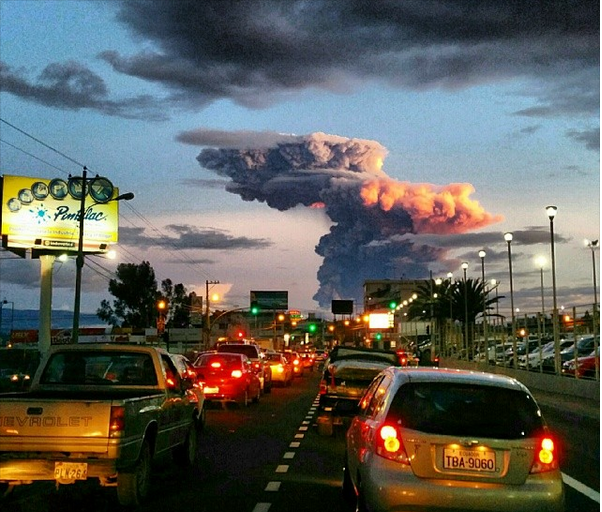
Ecuador’s ‘Throat Of Fire’ Volcano Belches Column Of Ash & Smoke

A Volcano in central Ecuador has spewed up a column of hot ash and smoke 10 kilometres high, increasing fears of an eruption.

Activity has been building at the Tungurahua volcano 130 kilometres south of the capital Quito since early February.


For more pics and video of the volcano follow the below link:


Three Explosions on the Sun!

Just lately the Sun has been providing quite a show, 2 X Class solar flares in the space of a few weeks and now, just last night, 3 explosions.  There is also the question if the 3 explosions were in fact one.


Check out the link below for some awesome footage and decide for yourself?
 

Wednesday, 12 March 2014

A telescope bigger than a galaxy!!

A friend of mine advised me of this story this morning and really is pretty awesome.

Astronomers have figured out how to use the gravity of distant galaxies to bend light and magnify images, forming gigantic telescopes that see deeper into the cosmos than ever before.

More than 400 years ago, Galileo turned a primitive spyglass toward the sky, and in just a few nights learned more about the unseen heavens than all of the scientists and philosophers before him, combined.

Since then astronomers have been guided by a simple imperative: Make Bigger Telescopes. As the 21st century unfolds, the power of optics has grown a million-fold. Telescopes cap the highest mountains, sprawl across deserts, fill valleys and even fly through space. These modern giants provide crystal-clear views of stars and galaxies billions of light years farther away than anything Galileo ever saw, each breakthrough in size bringing a new and deeper understanding of the cosmos.


For the full story click on the link below: